UK Student Life homepage
Study, work or travel in the UK. British culture and life.

Homepage
Search
A-Z index
Message Board
Contact us
Britain
Course
Life
Work
Links
English
Prepare
Personal
Travel
Ideas
Find a flatmate in a few clicks for free !
< Up
Life / Accommodation / London
Finding somewhere to live in London
     
Sections:
Maps
London (c) R.T.Allen
  London postcodes
  London boroughs
  Lettings agents
  Homestay accommodation
  Advertisements
  Hostels
  Managed accommodation for students / working holidaymakers
  Choosing an area
  Costs
  Safety
  Ethnic mix
  Links
   
Related pages:
Guide to renting accommodation
  Travel/Accommodation (short-term accommodation)  


MAPS


You will need several maps to help you find accommodation in London efficiently. You may find it convenient to obtain printed copies of these, although you can also refer to them online:
- A Tube map (for details about how to see this online, see the "journey planner" section of Travel/Transport/London/Underground)
- A London Connections map (for train services from London)
- A bus map. Maps for Central London, North-West London, North-East London, South-West London and South-East London are available free from bus stations (for details about how to see this online, see the "journey planner" section of Travel/Transport/London/Buses)
- A street map of London. The most popular is a London A to Z colour street atlas, which can be bought from newsagents in London or from the link below. Free online street maps are available from http://www.multimap.com or http://www.streetmap.co.uk or http://maps.google.co.uk

A-Z London
Publisher: Geographers' A-Z Map Company
Date: August 2008


LONDON POSTCODES


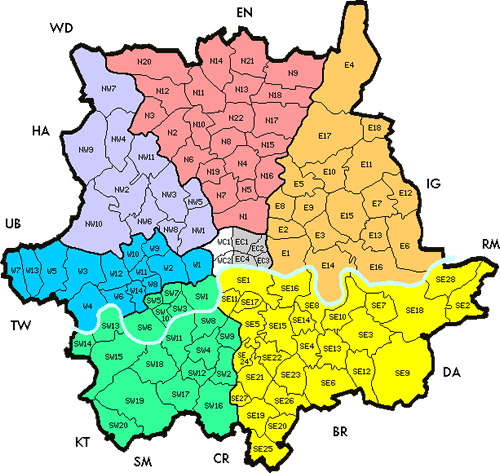
A postcode map of London is shown below. Postcodes are used by the postal service to deliver mail. They are often quoted in accommodation adverts and can be used to identify a location in online services such as maps, local service directories and transport route finders. If you know an address but not its postcode, you can use the postcode finder tool http://postcode.royalmail.com. If you want to live near a certain tube station, you may find it helpful to check the station's postcode at: http://www.tubeplanner.com/station. A map showing the boundaries of postcodes and administrative areas (boroughs) in London can be ordered using the link in the box above. The first two letters of a London postcode are WC (west central), EC (east central), N (north), E (east), SE (south east), SW (south west), W (west), or NW (north west) - the number that follows this is not logical, so you need to refer to a map to see where it is. Other postcodes used in outer London are (in clockwise order): EN (Enfield), IG (Ilford), RM (Romford), DA (Dartford), BR (Bromley), CR (Croydon), SM (Sutton), KT (Kingston), TW (Twickenham), UB (Uxbridge), HA (Harrow), and WD (Watford).

SW1 Victoria ; SW2 Brixton ; SW3 Chelsea ; SW4 Clapham ; SW5 Earls Court ; SW6 Fulham ; SW7 South Kensington ; SW8 South Lambeth ; SW9 Stockwell ; SW10 West Brompton ; SW11 Battersea ; SW12 Balham ; SW13 Barnes ; SW14 Mortlake ; SW15 Putney ; SW16 Streatham ; SW17 Tooting ; SW18 Wandsworth ; SW19 Wimbledon ; SW20 West Wimbledon
SE1 Bermondsey ; SE2 Abbey Wood ; SE3 Blackheath ; SE4 Brockley ; SE5 Camberwell ; SE6 Catford ; SE7 Charlton ; SE8 Deptford ; SE9 Eltham ; SE10 Greenwich ; SE11 Kennington ; SE12 Lee ; SE13 Lewisham ; SE14 New Cross ; SE15 Peckham ; SE16 Rotherhithe ; SE17 Walworth ; SE18 Woolwich ; SE19 Norwood ; SE20 Penge ; SE21 Dulwich ; SE22 East Dulwich ; SE23 Forest Hill ; SE24 Herne Hill ; SE25 South Norwood ; SE26 Sydenham ; SE27 West Norwood ; SE28 Thamesmead
WC1 Bloomsbury ; WC2 Holborn & Strand
W1 West End ; W2 Paddington ; W3 Acton ; W4 Chiswick ; W5 Ealing ; W6 Hammersmith ; W7 Hanwell ; W8 Kensington ; W9 Maida Vale ; W10 North Kensington ; W11 Notting Hill ; W12 Shepherds Bush ; W13 West Ealing ; W14 West Kensington
NW1 Camden Town ; NW2 Dollis Hill ; NW3 Hampstead ; NW4 Hendon ; NW5 Kentish Town ; NW6 Kilburn ; NW7 Mill Hill ; NW8 St Johns Wood ; NW9 Colindale ; NW10 Willesden ; NW11 Golders Green
N1 Islington ; N2 East Finchley ; N3 Finchley ; N4 Finsbury Park ; N5 Arsenal ; N6 Highgate ; N7 Holloway ; N8 Turnpike Lane ; N9 Lower Edmonton ; N10 Muswell Hill ; N11 Bounds Green ; N12 North Finchley ; N13 Palmers Green ; N14 Southgate ; N15 South Tottenham ; N16 Stoke Newington ; N17 Tottenham ; N18 Upper Edmonton ; N19 Upper Holloway ; N20 Whetstone ; N21 Winchmore Hill ; N22 Wood Green
E1 Whitechapel ; E2 Bethnal Green ; E3 Bow ; E4 Chingford ; E5 Clapton ; E6 East Ham ; E7 Forest Gate ; E8 Dalston ; E9 Homerton ; E10 Leyton ; E11 Snaresbrook ; E12 Manor Park ; E13 Plaistow ; E14 Poplar ; E15 Stratford ; E16 Canning Town ; E17 Walthamstow ; E18 Woodford
EC1 Clerkenwell ; EC2 Barbican ; EC3 Tower Hill ; EC4 Blackfriars

London Postcode and Administrative Boundaries Map
Publisher: Geographers' A-Z Map Company
Date: May 2008
   

Back to top


LONDON BOROUGHS


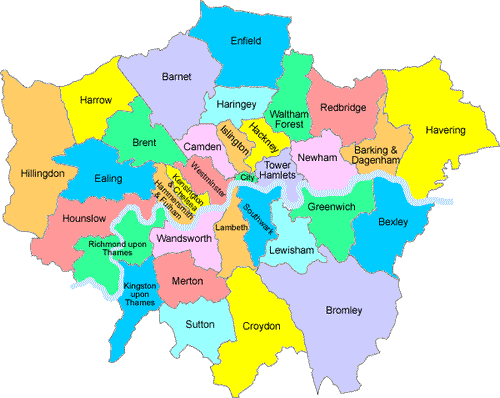
For local government London is divided into areas called boroughs:


You may find it helpful to check the website of the borough where you plan to live. You can use the links below to find out how much council tax you may need to pay and for information about local government services.

Borough Website
"Band D" council tax 2008/9
Barking & Dagenham http://www.barking-dagenham.gov.uk
£1326
Barnet http://www.barnet.gov.uk
£1393
Bexley http://www.bexley.gov.uk
£1399
Brent http://www.brent.gov.uk
£1343
Bromley http://www.bromley.gov.uk
£1263
Camden http://www.camden.gov.uk
£1332
City of London http://www.cityoflondon.gov.uk
£923
Croydon http://www.croydon.gov.uk
£1406
Ealing http://www.ealing.gov.uk
£1370
Enfield http://www.enfield.gov.uk
£1384
Greenwich http://www.greenwich.gov.uk
£1291
Hackney http://www.hackney.gov.uk
£1308
Hammersmith & Fulham http://www.lbhf.gov.uk
£1173
Haringey http://www.haringey.gov.uk
£1471
Harrow http://www.harrow.gov.uk
£1462
Havering http://www.havering.gov.uk
£1483
Hillingdon http://www.hillingdon.gov.uk
£1423
Hounslow http://www.hounslow.gov.uk
£1400
Islington http://www.islington.gov.uk
£1248
Kensington & Chelsea http://www.rbkc.gov.uk
£1068
Kingston-upon-Thames http://www.kingston.gov.uk
£1580
Lambeth http://www.lambeth.gov.uk
£1235
Lewisham http://www.lewisham.gov.uk
£1327
Merton http://www.merton.gov.uk
£1405
Newham http://www.newham.gov.uk/AboutNewham
£1255
Redbridge http://www.redbridge.gov.uk
£1376
Richmond-upon-Thames http://www.richmond.gov.uk
£1544
Southwark http://www.southwark.gov.uk
£1222
Sutton http://www.sutton.gov.uk
£1419
Tower Hamlets http://www.towerhamlets.gov.uk
£1175
Waltham Forest http://www.walthamforest.gov.uk
£1441
Wandsworth http://www.wandsworth.gov.uk
£687
Westminster http://www.westminster.gov.uk
£688

Back to top


LETTINGS AGENTS


To rent a private room in a house, you may want to contact lettings agents or estate agents in the area.
You can find an agent using UpMyStreet. Click here: http://www.upmystreet.com/findmynearest/search?category=lettings+agents&location=london, then enter a local postcode in the "located in" box and click on "search". The nearest ones will be listed first.

Note that some lettings agents do not deal with student accommodation, and some specialise in dealing with people from a particular country. It may be better to choose an agent which is a member of NALS (the National Approved Letting Scheme), see: http://www.nalscheme.co.uk. An agent may charge a fee when you have found somewhere (typically about a week's rent), but is not allowed to charge to show you a list of properties or to take details of your requirements. One advantage of using an agency is that you may be less likely to have problems with the landlord, and there should be a proper tenancy agreement. The disadvantages are that the accommodation may be more expensive (the landlord/landlady will charge higher rent to cover the cost of the agency), and that the choice of properties is more limited.

Back to top


HOMESTAY ACCOMMODATION


Homestay accommodation is a room in the house of a family (who are known as the host family).

Some organisations which help to arrange homestay accommodation in London are as follows (note that companies often specialise in certain areas of London):
UK Homestay: http://www.uk-homestay.com
Hosts International: http://www.hosts-international.com
London Host Families: http://www.londonhostfamilies.com
Host & Guest Service Limited: http://www.host-guest.co.uk
English Homestay Services: http://www.englishhomestayservices.com
City Homestay: http://www.cityhomestay.com
UK Guests: http://www.ukguests.co.uk
Jolaine Agency, 18 Escot Way, Barnet, Hertfordshire EN5 3AN Telephone: (020) 8449 1334

As a rough guide to prices:
- Expect to pay about £100 per week in zone 3 or 4 for self-catering accommodation in a standard single room, or £75 per week in a shared double room.
- Add £10 per week if you want to live in zone 2 (more central accommodation; rooms may be a bit smaller).
- Add £15 per week if you want breakfast ("bed & breakfast" or "B&B"), or £40 per week if you want breakfast and evening meals ("half board"), or £60 per week if you want breakfast, evening meals and packed lunches ("full board").
- Add £20 per week for superior accommodation (eg: a larger room, own toilet/bathroom, better food than standard).

There may be an additional one-off booking fee of perhaps £50 to the agent for arranging your accommodation.
Check if you need to pay and deposit and if so whether that will be returned to you when you leave.

The BBHA (Bed & Breakfast Homestay Association) has set minimum standards for homestay accommodation approved by Tourist Boards in London: http://www.bbha.org.uk.

If you are interested in helping an older person or someone with a disability, homesharing is another possibility. You live with this person and provide companionship and an agreed amount of practical help each week, in return for cheap accommodation. See: http://www.vitalise.org.uk/Vitalise-Centres-and-Services/Home-Services/Homeshare.aspx

Back to top


ADVERTISEMENTS


Local newspapers
If you have already decided you want to live in a particular area, buy the local newspaper from a newsagent (you may also be able to look at it in the local library or online). The Evening Standard is a London-wide evening newspaper which has some property adverts each day.

Loot
London accommodation adverts are available in Loot: http://www.loot.com/property
The paper version of Loot is published 5 times a week (a different colour each day). Sections you may wish to check include: Student accommodation (shared with other students), Bedsits & rooms, Flat & houseshare, Short lets (for example, accommodation that is available for less than three months), Flats to rent, and Houses to rent.

Capital Flatshare
Capital Flatshare is a section in the Space supplement of the London issue of The Guardian newspaper on Thursdays. Each week this lists some rooms for rent in a flat or house in the London area.

Online agents
The following websites list adverts for accommodation suitable for students:
Accommodation for Students: http://www.accommodationforstudents.com
Bunk: http://www.bunk.com
Student Pad: http://www.studentpad.co.uk
Student Accommodation: http://www.studentaccommodation.org
Housepals: http://www.housepals.co.uk
Generally these websites will allow you to search their adverts for free, but may charge you when you request contact details.

Newsletters/magazines/notice boards
Adverts are also contained in"TNT", a free magazine aimed mainly at travellers from Australia, New Zealand and South Africa (http://www.tntmagazine.com).
"Time Out" is a weekly magazine of event listings which also contains some accommodation ads.
Popular free online message boards include "gumtree" (http://www.gumtree.com) and "Craigslist" (http://london.craigslist.org).
Some countries' communities have their own London newsletters, or popular shops or places of worship where accommodation adverts are placed.
Schools/universities may have ads on their own notice boards, or may have accommodation offices which have been informed about available rooms.

Abbreviations
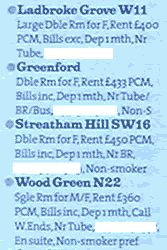
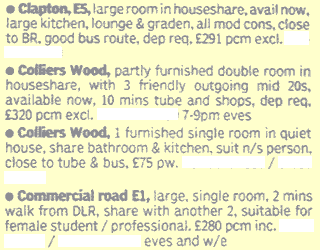
Accommodation adverts often contain abbreviations which will often not be found in a dictionary and might be confusing. Some of these abbreviations are explained below:

apt: apartment, flat; avail: available; b&b: bed & breakfast; b/sit: bedsit; bath: bathroom; bed: bedroom; BR: train station (British Rail); bth: bathroom; toilet; ch: central heating; cond: condition; cpl / cple: couple; d/g: double glazed; dbl or dble: double; dec: decorated; dep: deposit; DLR: Docklands Light Railway; DSS: person receiving unemployment benefit (from the Department of Social Security); eves: evenings; exc: excellent; excluding; excl: excluding heating/hot water bills; F: female; f/f: fully furnished, fridge-freezer; flr: floor; flt: flat; furn: furnished; gch: gas central heating; gd: good; gdn: garden; h&c: hot & cold water; HA: Housing Association; heat: heating; imm / immed: immediate; inc / incl: including heating/hot water bills; info: information; kit: kitchen; loc: location; lrg: large; lux: luxurious; M: male; mais: maisonette; min: minute, minimum; mod: modern; mth: month; n/s: non-smoker; nec: necessary; non-s: non-smoker; nr: near; o/l: overlooks; osp: off-street parking; pw: per week; pcm: per calendar month; pkg: parking; pls: please; pp: per person; pref: preferred; prof: professional; rd: road; refs: references required; req / reqd: required; rm: room; sep: separate; sgl or sgle: single; shw: shower; stn: station; stud: studio; tel: telephone; trans: transport; tube: underground train (London); TV: television; unfurn: unfurnished; vgc: very good condition; w: with; WC: toilet; w/d: washer-dryer; w/e: weekends; wkly: weekly; wks: weeks; wm: washing machine, warm, well-maintained

Below are a couple of examples of accommodation adverts:

Back to top


HOSTELS


A short-stay hostel in London can be used as a base when you first arrive in the UK, while you look for your own accommodation.
To find and book a short-stay hostels in London, see: Travel/Accommodation/Hostel

YMCAs provide some long-term accommodation (you do not need to be a Christian, and rooms are available both for men and women): http://www.ymca.org.uk

Back to top


MANAGED ACCOMMODATION FOR STUDENTS / WORKING HOLIDAYMAKERS


The following provide managed accommodation in London in shared houses or halls. Student rooms are primarily for people who are staying for a full academic year, but some short-stay rooms may be available.

IES Student Residence Hall: http://www.iesreshall.com (aimed at students)
International Student House: http://www.ish.org.uk (aimed at students)
Accommodation London : http://www.accommodationlondon.net (aimed at working holidaymakers)
Octavia Hill Estates: http://www.ohestates.co.uk
The Student Village (Greenwich): http://www.thestudentvillage.com
Sir John Cass Hall and Claredale House: http://www.cassandclaredale.co.uk (aimed at students)
Nido London: http://www.nidolondon.com
UNITE: http://www.unite-students.com/student-accommodation-london (aimed at students)

Back to top


CHOOSING AN AREA


Convenience
: Consider places along the transport links to your school or workplace (information in the Maps section may help). You may want to be close to an underground station or a bus route (or a night bus route if you are often out after midnight).
Cost: Look for adverts in local newspapers or Loot to judge the prices, and consider the transport costs as well as the rental costs (information in the Costs section may help). Decide on a range of rents that you can afford to consider.
Community: Decide on one or more boroughs (information in the Costs, Safety and Ethnic Mix sections may help). Decide on one or more local areas. Make a list of postcodes in these areas (information in the Maps section may help).

Once you have chosen an area that you think is convenient:
- Check the transport cost and timetable (first and last services; frequency of service). See: Travel/Transport/London
- Check the facilities in the area. See: Life/Accommodation/Guide for details of how to do this
- Visit the area; look for room advertisements by buying the local newspaper, looking in the windows of local newsagents. If you want to use a local letting agent or estate agent, visit some in the area. Ask if they deal with the type of accommodation that you are looking for, and if so, if they can show you a list of properties in the area which are within your price range. You can ask to register with them, so they can send you further details as they become available. Ask them if there are any charges: legally they are not allowed to charge you unless you have accepted a property shown to you by them. Often the charges are paid by the person who is renting the property (so the rent for these properties may be a little higher).

Back to top


COSTS


House prices (and also rental costs) are highest in central London, especially north of the River Thames. The most expensive boroughs are Kensington & Chelsea, the City of Westminster and the City of London. The map below shows in each borough the average price paid to buy a flat or maisonette in 2001, in thousands of pounds (source: the Land Registry).


Room rents
The prices of a room for one person within London in a flatshare (based on the adverts appearing in an issue of The Guardian's Capital Flatshare in April 2002):
- the cheapest 10% were less than £300 per month (£70 per week)
- 25% were £350 or less (£80 per week)
- 50% were £400 or less (£90 per week)
- 75% were £450 or less (£105 per week)
- the most expensive 10% were more than £500 per month (£115 per week).

If you are prepared to share with one other person in a twin-bedded room, the price is usually about 30% cheaper (the cheapest rooms are about £50 per week).

Deposits
The deposits required when renting a room in a flatshare (based of the adverts appearing in an issue of The Guardian's Capital Flatshare in April 2002):
- less than 1 month's rent in 20% of cases (of which half were 2 weeks or less; a few rooms did not require any deposit)
- 1 month's rent in 70% of cases
- more than 1 month's rent in 10% of cases (of which half were for 6 weeks or more; no room required more than 2 months' deposit).

Travel costs
Remember to consider the cost of travelling as well as the rent.
See Travel/Transport/London for details of tickets and fares, including prices if you hold a Student Photocard.

Back to top


SAFETY

Crime rates
The map below shows the number of criminal offences per 1,000 resident population in 1998-99 (source: City of London and Metropolitan Police Forces).
Crime rates are highest in central London boroughs.


Back to top


ETHNIC MIX

In London, about 77% of people are white, 9% black, 9% Indian/Pakistani/Bangladeshi, and 5% of other ethnic origin. The greatest concentrations of black people are in Brent, Hackney, Haringey, Lambeth, Lewisham, Newham, Southwark and Waltham Forest. The greatest concentrations of Indian/Pakistani people are in Brent, Ealing, Harrow, Hounslow, Newham, Redbridge and Waltham Forest; the Bangladeshi community is centred in Tower Hamlets and Camden.
There are local communities in London for people coming from many different cultures. To find out where these are located, see the Links for your country.
The map below shows the percentage of the population within each borough which is white (source: UK census)

For maps showing the locations where Bangladeshi, Black African, Black Caribbean, Chinese, Indian, Irish, Pakistani and White British communities are concentrated, see: http://www.guardian.co.uk/graphic/0,5812,1395103,00.html

Back to top


LINKS

Accommodation issues: Life/Accommodation/Guide
Booking hostels: Travel/Accommodation/Hostel

Home page: Home

Back to top

© UK Student Life 2002-2009


* Search this website (www.ukstudentlife.com) or the web:
Google
 
Web www.ukstudentlife.com